
Independent Key West moving guide
Key West Movers: Local Costs, Long-Distance Prices, Licenses, and Two Companies to Compare
Compare source-verified Key West moving options, local and long-distance planning costs, Florida and federal credentials, island access charges, estimates, valuation, storage, and move-day controls.
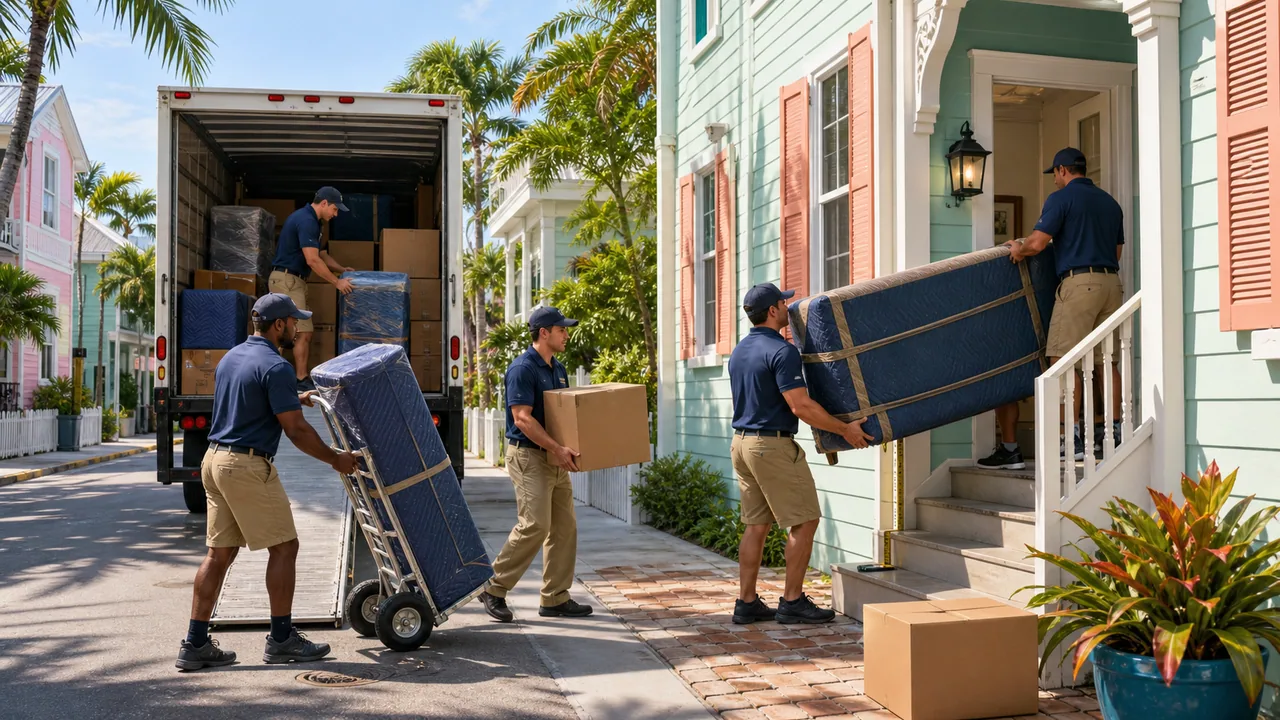
A six-mile move across Key West can be harder to price than a much longer mainland job. The truck may not reach the front door. An Old Town house may have a tight stair turn and nowhere legal to stage. A condominium may allow one protected elevator window. A Sunset Key delivery can add receiving, storage, and a barge handoff. None of that appears in a bedroom count, yet all of it can change the crew, equipment, elapsed time, and final bill.
The local market is also thinner than many search results suggest. Two companies have enough current identity and service evidence for a useful comparison: DRN Moving, a Key West-addressed carrier that publishes local, Florida, interstate, and island-specific services; and American Van Lines, a Pompano Beach-headquartered interstate carrier with a dedicated Key West long-distance page. They are not interchangeable. Other names remain discoverable in the directory, but they do not belong beside source-resolved carriers until the legal mover or broker identity and Key West service boundary can be matched.
Moving within, to, or from Key West
Tell the mover where the truck can stand
Start with both addresses and the move date. Add the building access and unusual pieces that can change the crew or equipment; the quote form keeps that job detail with your contact information.
Local businesses compared
These are identity-checked local profiles, not paid placements. The fit notes describe differences supported by current official information; ratings shown remain attributed to their outside source.
- Model
- Key West-addressed carrier advertising local Florida Keys moves, intrastate and interstate flat-rate work, packing, receiving, commercial moving, specialty handling, and Sunset Key delivery.
- Best starting fit
- A first quote for a local Key West move, a move elsewhere in Florida, or a Keys-origin interstate shipment that may involve difficult access, storage, fine art, a piano, or water-dependent delivery.
- Why it is on this list
- DRN's official site publishes Florida IM26, USDOT 966624, MC 450645, the 305-295-6683 phone, and Florida Keys service. The current FMCSA snapshot matches DRN Moving Inc, that phone, and 121 Overseas Highway #105 in Key West, and lists authorized interstate household-goods authority.
- Confirm before booking
- Identity and authority do not establish price or job quality. Recheck the applicable Florida or federal record before booking and put the survey inventory, access charges, estimate type, crew, carrier, delivery window, storage, valuation, deposit, and claim terms in writing.
- Model
- Pompano Beach-headquartered interstate household-goods carrier advertising long-distance service for Key West, with flat-rate estimate positioning, packing, storage, military moves, and specialty-item handling.
- Best starting fit
- A comparison quote for an interstate or other long-distance shipment beginning or ending in Key West, particularly when the customer wants a carrier—not an unidentified lead seller—to price a surveyed shipment.
- Why it is on this list
- The official Key West page publishes USDOT 614506 and MC 294798 and says American Van Lines is a carrier rather than a broker. The current FMCSA snapshot matches the existing RealReviews headquarters entity, American Van Lines Inc at 1351 NW 22nd St Ste 210 in Pompano Beach, and lists active interstate household-goods authority.
- Confirm before booking
- The city landing page does not establish a Key West office or a local-only Key West moving operation. Treat its route prices as company-published examples, verify current authority and pickup responsibility, and require a written estimate based on your inventory and access.
First decide whether the move is local, intrastate, or interstate
Route classification comes before company ranking. A move from Old Town to New Town is local. Key West to Miami, Orlando, or Jacksonville remains intrastate because the shipment never leaves Florida. Key West to Atlanta, Charlotte, Memphis, or Boston is interstate. That distinction determines which registration record, estimate rules, liability framework, and complaint channel belong in the comparison.
For an intrastate household move, Florida requires the mover or moving broker to register with the Florida Department of Agriculture and Consumer Services. The advertising and contract should identify the Florida mover registration, often shown as an IM number. Ask for the legal name behind the brand and search that exact entity. A familiar logo, Key West phone number, or high directory rating does not replace the state record.
For interstate household goods, use the Federal Motor Carrier Safety Administration records. Determine whether the seller is the carrier that will transport the shipment or a broker arranging another carrier. Record the legal company name, USDOT number, operating-authority status, MC number when applicable, physical address, and phone. If a broker is involved, obtain the assigned carrier before pickup and verify that carrier separately.
The product matters too. Labor-only loading, a rental truck with hired helpers, a container, a full-service local crew, and a carrier-managed interstate shipment allocate driving, equipment, valuation, storage, and claims differently. A lower number can simply mean the customer is buying less. Put each proposal into the correct route and service column before comparing totals.
- Within Florida: verify the legal mover or broker through FDACS.
- Across a state line: verify carrier or broker status and authority through FMCSA.
- Key West to Miami is intrastate even though the drive is long.
- Labor-only, container, and full-service proposals are different products.
What a local Key West move costs
There is no defensible island-wide tariff for a local move. A current GreatGuys planning model estimates about $546 for a one-bedroom move using two movers and a truck, $1,228 for a two-bedroom move using three movers and a truck, and $3,275 for a four-bedroom move using four movers and a truck. The publisher describes the figures as rough estimates based on local and national data. They are useful budget markers, not promises from a Key West mover.
DRN describes local pricing in operational terms: the number of movers, elapsed moving time, and drive time between residences. That is the right framework for testing a quote. If a proposal lists three movers at an hourly rate, ask when the clock begins, the minimum number of hours, how travel is charged, whether the truck and fuel are included, and which tasks can add time. Then add any fixed materials or specialty charges before comparing it with a flat-rate offer.
Bedroom count stops being useful when the crew reaches the door. Ten dense antiques upstairs in a conch house can take more protection and labor than a lightly furnished two-bedroom condo with an elevator. A larger home can be the easier job when the driveway is open, cartons are ready, furniture is already apart, and the carry is short. The estimator needs those conditions, not only the number of bedrooms.
Ask each estimator to show every possible local add-on: cartons and packing materials, packing and unpacking labor, appliance preparation, stairs, elevator time, long carry, shuttle vehicle, bulky or fragile items, disassembly and reassembly, waiting, storage handling, disposal, overtime, weekend scheduling, tax, and card fees. A quote that says miscellaneous charges may apply is not complete enough to rank.
- Rough one-bedroom planning point: about $546.
- Rough two-bedroom planning point: about $1,228.
- Rough four-bedroom planning point: about $3,275.
- Use the mover's written surveyed estimate—not the planning model—as the booking price.
Long-distance prices from Key West: useful examples, not a market average
American Van Lines publishes several planning ranges on its Key West long-distance page. A studio or one-bedroom shipment from Key West to Memphis, 882 miles, is shown at $2,283–$5,123. A similar shipment to Dallas, 1,072 miles, is shown at $2,607–$5,134. These are the carrier's own examples and should be read as an invitation to obtain a surveyed quote, not as evidence that every mover or shipment will fall inside the range.
The larger-home examples widen rather than settle the budget: American Van Lines shows $2,597–$6,094 for two or three bedrooms to Houston and $3,059–$6,419 to Boston. Its four-bedroom-or-larger examples run from $4,527–$7,550 to Charlotte and $7,809–$12,150 to Bakersfield. Mileage is visible; shipment size, packing, storage, access, valuation, and timing are not.
Suppose the Boston range is the starting point. The useful follow-up is not “Can you do the low number?” It is “What did that number include?” Put the surveyed weight or inventory, packing assumption, delivery spread, and access beside the price. Piano handling, crating, a shuttle, storage, or an extra pickup sits on its own line when it is not inside the flat rate.
A delivery spread also has a household cost. If the truck arrives ten days after a lease begins, hotel nights, meals, clothing, and replacement basics can erase a cheaper transportation quote. Record the pickup window, delivery spread, whether either is guaranteed, and the contract remedy for delay.
Give the estimator a move file, not a bedroom count
The first page of the file is the route: full addresses and unit numbers, property type and floor, the legal truck position, carry distance, stairs, elevator size and reserved time, dock or gate, low clearance, and any limit on crew hours. Attach the building sheet when it calls for a certificate of insurance, deposit, protected elevator, approved vendor, or advance notice.
The second page is what moves. Count cartons by size, work room by room, and name furniture, appliances, televisions, mirrors, art, bicycles, grills, outdoor pieces, and grouped storage bins. Put safes, pianos, stone, large glass, antiques, aquariums, wine, motorcycles, and oversized appliances in a separate margin. Photos of closets, garages, stairs, doors, and the largest pieces show what a tidy list hides. Beside that inventory, mark who packs, supplies cartons, takes furniture apart, disconnects appliances, crates art, removes mounted items, unpacks, reassembles, disposes of debris, makes an extra stop, or handles storage.
Date the file. It should show the preferred move date and alternatives, earliest pickup, latest acceptable delivery, lease or closing deadlines, building windows, travel plans, storage gaps, and anything that must stay accessible. Send the same version to each finalist. A changed inventory or access plan gets a new date and a revised written estimate before loading.
- Exact addresses, property types, floors, truck positions, and carry distances.
- Room-by-room goods list plus photographs or a live video survey.
- Packing, unpacking, disassembly, storage, disposal, and extra stops.
- Pianos, safes, art, glass, antiques, wine, and other specialty goods.
- Move dates, building windows, lease or closing deadlines, and alternatives.
- A written revision whenever material scope changes.
Verify the company behind the website and phone number
For a Florida move, ask the salesperson to write the contracting legal entity and Florida registration number in the proposal. FDACS says intrastate movers and moving brokers register biennially. Florida advertising must show the mover registration language and number, and the contract must identify the registered firm. Search the current state record and compare its entity, status, address, and contact information with the agreement.
For an interstate move, search the USDOT number through FMCSA and examine the current company snapshot and licensing-and-insurance record. Confirm that the name on the estimate matches the carrier or broker in the record. An active USDOT number alone is not the entire check; review operating authority for household goods, entity type, physical address, phone, and the company that will possess the shipment.
DRN's current federal snapshot identifies DRN Moving Inc at 121 Overseas Highway #105 in Key West, phone 305-295-6683, USDOT 966624, and MC 450645. It lists the entity as an interstate carrier authorized for household goods. DRN's official site separately publishes Florida IM26. Recheck both records for the actual route because status can change after this guide's July 26, 2026 research date.
American Van Lines' current federal snapshot identifies American Van Lines Inc at 1351 NW 22nd St Ste 210 in Pompano Beach, phone 954-630-0316, USDOT 614506, and MC 294798, with interstate household-goods authority. That exact headquarters is the existing RealReviews profile linked here. The company's separate long-distance Key West service page does not turn the Pompano Beach headquarters into a Key West office. Geographic precision matters when arranging surveys, storage, claims, and local-only work.
Compare written estimates line by line
Florida's consumer guidance says the intrastate mover must provide a written estimate and contract before service. The documents should identify the mover and registration, preparation and move dates, shipper, pickup and delivery addresses, any storage location, itemized services and charges, total, and accepted payment methods. Dates for packing, loading, and delivery belong in the contract. A text-message total with no legal company or scope is not a complete substitute.
On an interstate proposal, “binding” applies to the shipment and services actually listed. Added goods or access can still require a written revision. A non-binding estimate follows actual weight and services instead; FMCSA describes a 110-percent limit on what the mover can demand at delivery, with the balance handled later under federal rules.
Three quotes may be measuring three different products. The weight quote should yield tare and gross tickets. An inventory or volume flat rate needs the goods list and the rule for additions. The hourly local bid needs crew size, rate, minimum, clock start and stop, travel calculation, and overtime. Packing, materials, storage, a shuttle, stairs, long carry, specialty handling, valuation, and tax remain separate unless the proposal plainly includes them.
Use one comparison row for each likely charge. “Included” needs a cap; “as needed” needs a price and a trigger. The useful total is transportation plus the services this move is likely to use, not whichever bold number is largest.
- Identity row: legal mover, registration or USDOT number, carrier or broker.
- Scope row: the same goods, access, route, packing, storage, and dates.
- Price row: binding, non-binding, flat-rate, or hourly.
- Exceptions row: each extra service, its unit price, and its trigger.
- Final record: written changes before loading and no blank documents.
Run the truck-and-door test before pricing Old Town or a condo
Pin the truck on the map before accepting the labor number. The carry begins at the legal stopping place, not at the street address. In Old Town, a lane, gate, porch, landscaped edge, or stair turn can force a smaller vehicle, another handling step, more time, or different equipment. Put the expected truck position and carry distance in the estimate.
A condominium adds the management sheet. Send the allowed hours, service entrance, elevator size and reservation, padding rule, loading position, height limit, gate process, certificate wording, vendor approval, deposit, and carton-staging rule before the survey. Any expected wait or added labor then belongs in the written price.
Now test the largest piece. Measure the relevant doorway, stair turn, elevator opening, low ceiling, and any balcony route. Record whether the mover will disassemble, protect, hoist, crate, or decline it. A general piano or fine-art service page does not put that particular item through that particular turn.
The same file should say who covers floors, rails, doors, elevators, and common areas and how existing damage is recorded. Photograph both properties. When the building names an additional insured or certificate holder, get the certificate accepted before assigning the truck.
Sunset Key requires a separate logistics plan
A water-dependent delivery is not an ordinary local move with one extra address. Goods may need to be received, inventoried, stored, staged for a barge, transferred, protected from weather, delivered on the island, unpacked, and set up. Every handoff adds scheduling, custody, handling, and damage questions. Price the chain from the first truck door to the final room.
DRN publishes a Sunset Key service involving receiving, storage, barge delivery, and setup. That makes it a relevant company to ask; it does not guarantee the date, property authorization, vessel capacity, item eligibility, or price. Request the current process and identify which business books and operates the barge, which party controls the schedule, and who has custody at each point.
Write the handoff as three custody lines: truck to receiving address, receiving or storage to the barge, and island landing to the residence. Each line names the inspecting party, inventory record, storage or handling charge, weather or mechanical fallback, missed-connection responsibility, and next delivery window. The same agreement settles property access, packaging disposal, setup, and what happens when the home is not ready.
Give condition-sensitive pieces their own record. Photograph them before the first pickup and, when practical, at visible handoffs. The valuation question is simple but important: does the selected protection continue through receiving, warehouse storage, barge staging, water transfer, and setup? When custody changes companies, record the liability and claim contact for that leg.
Read a packing quote by the carton and the handoff
Separate the packer's time from the materials invoice. The price sheet should name carton types and unit prices, specialty crates, wardrobe and dish boxes, tape, wrap, paper, mattress protection, and returnable containers. It should also say what “full,” “partial,” and “unpacking” mean. Opening a carton onto the nearest counter is not the same job as organizing the room; debris removal and final placement need names too.
For owner-packed cartons, get the mover's box standard, prohibited-items list, and claim rule first. Medication, identification, keys, cash, jewelry, irreplaceable records, essential electronics, and the first-night kit travel with the household, not in the truck. Number the remaining cartons, note their contents and destination rooms, and photograph valuable contents before closing them.
Storage creates at least two additional handlings: into and out of the facility. Clarify whether the product is storage-in-transit under the moving agreement, warehouse storage, or delivery to a self-storage unit. Record the facility, climate conditions, access rights, inventory method, monthly minimum, payment, notice, valuation or insurance, retrieval lead time, warehouse handling, and final-delivery charge.
Pianos, safes, stone, antiques, artwork, oversized glass, aquariums, motorcycles, and unusually heavy pieces belong in the survey by name. Ask who performs the work, whether a subcontractor is used, which equipment or crating is planned, how access was evaluated, and what exclusions apply. DRN and American Van Lines both advertise specialty handling, but a service category is not approval for a specific item or route.
Calculate valuation before choosing the cheapest liability option
Moving liability is not automatically replacement-cost insurance. Florida says an intrastate mover must disclose its limitation of liability and offer the opportunity to select additional valuation. The state's released-liability floor cannot be lower than 60 cents per pound per article. Under that formula, a 12-pound lamp would produce only $7.20, even if replacing the lamp costs hundreds or thousands of dollars.
Interstate paperwork presents two different choices. FMCSA requires an offer of Full Value Protection, under which the mover generally may repair an item, replace it with a comparable item, or settle in cash according to the agreement. The lower released-value option pays far less. The signed declaration—not the sales description—controls the deductible, exclusions, maximums, and special treatment of high-value articles.
Create a high-value inventory with item descriptions, serial numbers, receipts or other value evidence, and current condition photographs. Ask which articles must be separately declared and whether pairs, sets, owner-packed cartons, mechanical condition, internal damage, jewelry, art, wine, or electronics have special rules. If a third-party specialist handles an item, establish which company's liability applies during that work.
Check homeowners, renters, condominium, and separate transit coverage, but do not assume a policy follows goods through packing, a warehouse, or a professional move. Ask the insurer in writing about transit, storage, deductibles, exclusions, and subrogation. The rational choice compares the cost of protection with the shipment's replacement value and the loss the household can absorb.
Put a dollar value on the promised date
A salesperson's confident date has no contractual remedy by itself. The written version should show when equipment and crew are committed, whether pickup is a date or a window, when local billable time begins, and the long-distance delivery spread. If guaranteed service is sold, record its price and what the mover owes when it misses.
Write the deposit amount, payment method, refund deadline, postponement rule, cancellation fee, balance timing, card fee, and who may authorize changes. FMCSA lists large cash deposits, sight-unseen estimates, missing rights materials, vague company identity, blank documents, and last-minute name changes among warning signs. Stop if the legal company or total cannot be documented before loading.
Key West weather planning should be concrete. Ask who decides to postpone for a tropical system, bridge or road condition, unsafe heat, flooding, or unavailable building access; whether packed goods can be stored; how storage is charged; whether the deposit transfers; and where the shipment is protected. Neither side should have an unlimited verbal weather exception.
Leave schedule margin around lease surrender, closing, flights, elevator reservations, work start dates, and lodging. For an interstate delivery spread, keep essential medication, documents, work equipment, clothes, bedding, and household basics outside the shipment. The cost of a missed hard deadline belongs in the company and service decision even when it is not part of the mover's invoice.
DRN Moving: the source-resolved local and mixed-route option
DRN is the only company in this research set with a current Key West physical address in the federal carrier record and an official site that clearly spans local, Florida, interstate, and Keys-specific work. The site says it serves Key West, Big Pine Key, Marathon, Key Largo, and the rest of the Florida Keys. It publishes IM26, USDOT 966624, and MC 450645.
The current FMCSA snapshot aligns the legal name DRN Moving Inc, 121 Overseas Highway #105, phone 305-295-6683, active USDOT status, interstate operation, and authorized household-goods authority. A Key West Chamber listing independently aligns the local name, address, and phone. Those records resolve identity; they do not score communication, care, punctuality, claims, or price.
The official service menu is unusually relevant to local conditions: local hourly-style moves, flat-rate Florida and interstate moves, packing, boxes, business and office moves, piano and fine-art handling, receiving and delivery, and Sunset Key barge deliveries. The page says local cost depends on crew, elapsed time, and drive time. For flat-rate work, it points to distance and the amount moved, with other service and access details requiring the actual estimate.
No normalized set of at least five independent review bodies was accessible and inspected for the profile. An official testimonial and an outside aggregate are not enough to describe recurring sentiment. DRN is therefore the strongest identity-and-scope starting point, not a guaranteed winner. Compare the current written proposal, verify route-specific authority, and test every island access or specialty claim against the actual property and item.
American Van Lines: a long-distance Key West service, not a local office
American Van Lines belongs in this comparison for a different reason. Its official site publishes a dedicated page for long-distance moves from Key West and states that it operates as a carrier rather than a broker. The page lists USDOT 614506 and MC 294798, binding flat-rate estimate positioning, packing and unpacking, storage, furniture assembly, military moves, and piano, antique, and specialty handling.
The current FMCSA snapshot resolves American Van Lines Inc as an interstate carrier authorized for household goods. It gives a physical address of 1351 NW 22nd St Ste 210 in Pompano Beach and phone 954-630-0316. That is the existing headquarters profile on RealReviews. The official contact material is consistent with the headquarters, and no evidence supports a Key West office, warehouse, or local-only crew.
The dedicated city page's route ranges are valuable because they are more specific than a generic national cost article. They remain provider estimates. The household-size label does not reveal the final shipment weight, inventory, access, valuation, dates, packing, storage, or delivery spread for a reader's home. Use the range to set a budget interview, then require a surveyed written price and a list of inclusions.
National BBB and ConsumerAffairs material establishes that public feedback exists, but it is not a normalized Key West-specific corpus. We did not synthesize praise or complaints from it. American Van Lines is a defensible long-distance quote candidate when its carrier model fits; it is not the evidence-based answer for a move solely within Key West unless the company separately documents that service and applicable Florida registration.
Why several search-result names are not comparison cards
A useful comparison cannot silently switch from verified companies to names that merely appear for the query. We found Key West and Florida Keys mover pages whose phones and websites aligned at a surface level but whose current legal mover or broker entity, Florida registration, federal status, or actual Key West service boundary could not all be resolved. Those businesses may be legitimate; the evidence packet is incomplete.
Keys Movers advertises local and Florida moving under a Key West phone, but the inspected official material did not display a Florida IM number or a clearly matched legal registered entity. Key West Mover's advertises residential, commercial, local, and long-distance work, but the legal carrier, Florida registration, USDOT authority, and broker role were not clear. Rob Moves lacked enough official identity and credential evidence for an editorial comparison.
Key Largo, Marathon, and Key West are not interchangeable service locations. When an Upper Keys company says it serves Key West, its proposal needs the crew's origin, travel charge, minimum, equipment, schedule, contracting entity, and transporting carrier. A directory result alone proves none of those things.
Unresolved profiles should remain weak or noindex until the evidence improves. They stay out of this comparison while the company record has identity or service gaps. An owner can provide the legal entity, registration, official domain, address or explicit service area, current contact details, and supporting service material through the correction or claim path. Until then, discovery inventory is not an editorial recommendation.
Keep one record from the empty truck to the final signature
Before loading, match the arriving company, truck, foreperson, and papers to the legal mover on the estimate. Photograph the origin and the existing condition of floors, rails, doors, elevators, furniture, and fragile pieces. The working copy of the inventory also shows what stays, what the customer carries, the valuation choice, and every signed revision.
Give one person the origin keys, gate codes, elevator contact, parking instructions, pet plan, and loading decisions. A second person can prepare the destination when timing requires it. Medication, identification, payment access, and essential records remain outside the shipment. The origin walk-through ends only after rooms, closets, cabinets, attic, balcony, storage, appliances, and outdoor areas are checked.
At delivery, read from the mover's inventory. Wet, crushed, missing, scratched, broken, or mishandled items and property damage are photographed and written on the delivery record before an exception-free signature. Keep relevant packaging and use the mover's written claim procedure; a verbal assurance is not a filed claim.
The interstate folder continues past delivery: estimate, order for service, bill of lading, inventory, applicable weight tickets, valuation selection, high-value declaration, storage papers, receipts, messages, delivery record, photographs, and claim submission. Those contemporaneous records are what make an FMCSA or FDACS complaint intelligible.
What the mover needs before returning a useful number
A name and phone number cannot price a move. The first screen keeps the customer's name, email, phone, preferred contact method, both addresses, local or interstate route, preferred date and alternatives, property types, bedroom count, carton estimate, and a choice between a room inventory and a survey.
The job screen handles the part that changes labor: floors, stairs, elevators, carry distance, loading position, parking, gates, docks, truck limits, insurance certificates, and building windows. Packing, unpacking, cartons, disassembly, storage, extra stops, disposal, vehicles, and named specialty pieces—pianos, safes, art, antiques, glass, wine, or an aquarium—stay attached to the same request.
The last screen records hard pickup or delivery deadlines, a storage gap, first-night necessities, high-value goods, valuation interest, and permission to share the job with relevant movers. A signed-in customer can reuse contact information without locking the job to the wrong phone or email. The confirmation repeats the submitted scope and makes clear that the mover still has to survey the shipment and issue its own estimate.
Matching follows the job. A local-only request should not default to a long-distance carrier; Sunset Key needs the water-transfer flag; an interstate shipment needs current federal household-goods authority. The result should be a small set of relevant responses, not an uncontrolled lead blast.
Sources and verification
Rules and public requirements link to the responsible agency. Business-specific service claims are checked against privately retained official material, while public ratings remain attributed to their original source. RealReviews does not turn outside reviews into invented testimonials, blend unrelated platforms into a house score, or sell placement in these comparisons. Recheck licenses, availability, scope, and price before hiring.
Frequently asked questions
How much do movers cost in Key West?
For early local planning, one current independent model estimates about $546 for one bedroom, $1,228 for two bedrooms, and $3,275 for four bedrooms. Those are rough modeled figures, not Key West tariffs or quotes. The written total should price crew and time or a flat rate plus travel, truck, parking, carry distance, stairs or elevator, packing materials, storage, specialty goods, valuation, and tax.
What does a long-distance move from Key West cost?
American Van Lines currently publishes $2,283–$5,123 for a studio or one-bedroom Key West-to-Memphis example, $2,607–$5,134 to Dallas, $2,597–$6,094 for two or three bedrooms to Houston, and $3,059–$6,419 to Boston. These are American Van Lines' first-party planning ranges, not independent averages or guaranteed quotes. Your surveyed inventory, route, access, service, storage, dates, and valuation determine the written estimate.
Which moving company should I call first for a local Key West move?
DRN Moving is the strongest source-resolved first call in this research. Its Key West address and phone align with the current FMCSA carrier record, and its site publishes Florida IM26, USDOT 966624, MC 450645, Keys-wide service, and local moving. That is an identity-and-scope finding, not a guarantee: recheck the current Florida registration, compare at least three detailed estimates, and judge the actual contract.
Is American Van Lines located in Key West?
No verified Key West office was found. American Van Lines publishes long-distance service for Key West, but its existing RealReviews headquarters profile and the current FMCSA record place American Van Lines Inc at 1351 NW 22nd St Ste 210 in Pompano Beach. Use it as a long-distance carrier comparison, not as proof of a local Key West branch or a local-only moving product.
How far ahead should I book a Key West mover?
Start planning 2-6 weeks before an ordinary Florida move; FDACS specifically recommends that range and at least three detailed estimates. Start earlier for summer or month-end dates, an interstate delivery window, a fixed closing, condominium approval, specialty items, storage, or Sunset Key delivery. Verify the company and cancellation terms before paying.
How do I verify a Key West moving company?
For a move entirely inside Florida, obtain the exact legal mover or broker name and Florida IM registration, then verify it through FDACS. For a shipment crossing a state line, search the USDOT number through FMCSA and confirm legal name, carrier or broker type, active household-goods authority, address, phone, and the carrier that will transport the shipment. Match those facts to the estimate before paying.
Should I get a binding or non-binding estimate?
Choose a binding interstate estimate when price certainty for the exact listed shipment and services matters most; added goods or services can still require a written revision. Choose a non-binding estimate only when you accept that actual weight and services determine the final price. Either one is unsafe when the inventory or access is vague. Require a survey, complete goods list, measurement method, access charges, and written changes before loading.
How much would released liability pay for damaged furniture?
Florida's minimum released-liability formula can be as low as $0.60 per pound per article. A 12-pound lamp would therefore produce only $7.20, regardless of a much higher replacement price. Ask for the dollar outcome on your own high-value goods, compare added valuation or Full Value Protection, declare items when required, and check separate insurance.
Can a moving company deliver to Sunset Key?
Yes. DRN specifically advertises receiving, storage, barge delivery, and setup for Sunset Key. Obtain property approval and a written plan naming the receiving location, custody, inventory, storage, barge operator and charge, weather rule, missed-handoff responsibility, item restrictions, final delivery window, setup, valuation, and claim path.
What should I include in a Key West moving quote request?
Include contact information, exact pickup and delivery addresses, route, preferred and alternate dates, property type, floors, stairs, elevators, truck position and carry, building requirements, a room-by-room inventory, carton estimate, photographs, packing and assembly, storage, extra stops, specialty goods, high-value items, valuation interest, and hard deadlines. Ask for an in-person or video survey and a revised written estimate after material changes.