
Independent Key West restoration guide
Key West Water-Damage Restoration: First Steps, Costs, Insurance, Mold, and Companies
A practical Key West water-damage guide covering immediate safety, the 24-48 hour drying window, clean versus contaminated water, restoration estimates, insurance documentation, mold rules, and companies serving Key West.
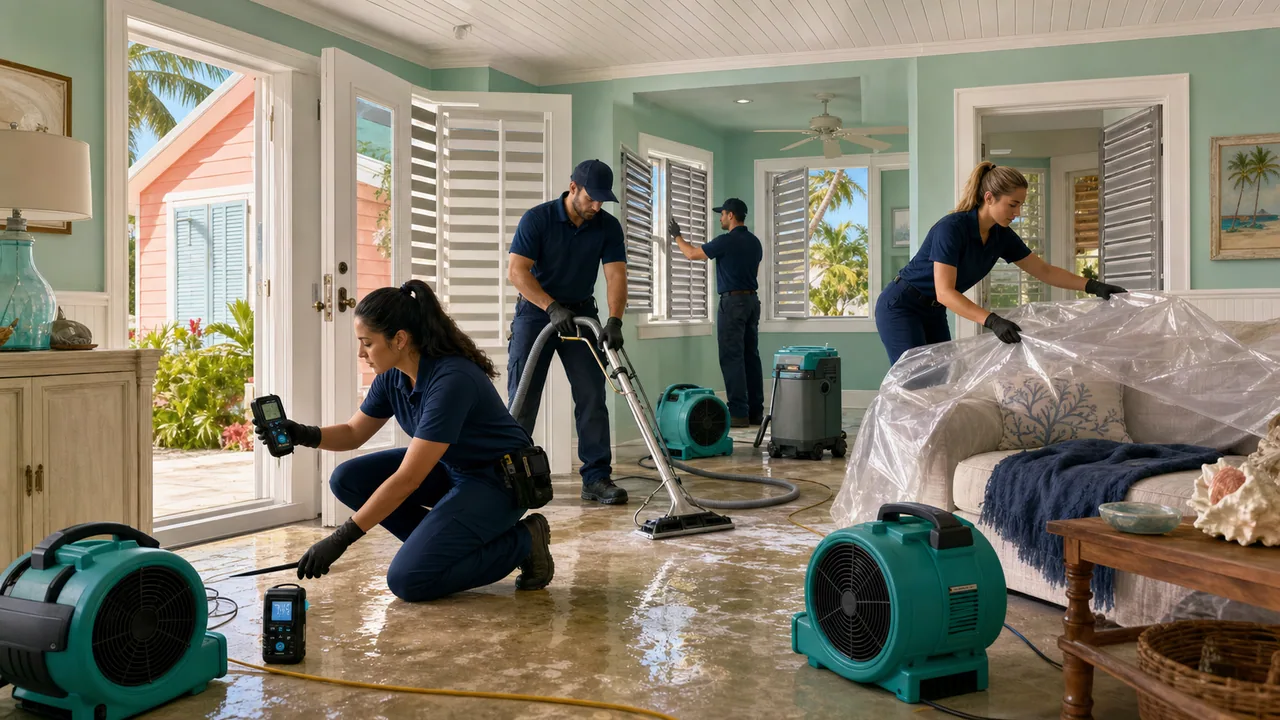
When water enters a Key West property, the first useful decision is not which company has the loudest emergency ad. It is whether the building is safe to enter, whether water is still moving, what materials are wet, and how quickly extraction and controlled drying can begin. A supply-line leak in a second-floor condo, wind-driven rain through a roof, an AC drain overflow, and salt or sewage-contaminated floodwater are not the same job.
The first call should identify the water source, affected rooms and materials, electricity or structural hazards, contamination risk, time discovered, access, insurance contact, and whether the source has stopped. The written drying scope should then separate emergency stabilization, extraction, demolition, monitoring, mold assessment or remediation when triggered, reconstruction, contents, and insurance documentation.
Restoration companies serving Key West compared
These are identity-resolved service-area profiles, not a list of verified Key West offices or paid placements. Compare the published base, coverage, scope, credential evidence, outside signal, and the dispatch facts that still require direct confirmation.
SERVPRO of Florida Keys
Google Places 5.0 · 1 review- Verified base
- The current official franchise page labels the operation's service area as Key Largo, Florida; the stored 1206 White Street address is not supported as a current office.
- Published coverage
- Florida Keys franchise coverage is published, but the page does not establish a Key West storefront or an accepted dispatch for a specific property.
- Service scope
- Water, fire, mold, storm, sewage, contents, specialty cleaning, roofing, and construction are published service categories.
- Credential evidence
- The service menu is not job-specific credential evidence. Verify the legal entity, assigned contractor or mold professional, insurance, subcontractors, and authorized phase.
- Independent signal
- The exact RealReviews record carries an attributed Google Places 5.0 from 1 review. That single outside rating does not establish current Key West response, price, or workmanship.
- Dispatch confirmation
- Ask which franchise and crew accepted the request, where the crew and equipment will originate, the arrival status, travel or after-hours charges, and which mitigation and reconstruction phases are authorized.
- Model
- SERVPRO franchise publishing 24-hour response and residential and commercial water, fire, mold, storm, contents, specialty-cleaning, roofing, and construction services.
- Best starting fit
- Owners who want one organization to assess mitigation, contents, specialty cleaning, and a documented reconstruction handoff.
- Why it is on this list
- The current official franchise page publishes 305-328-9111, identifies the owners, and lists water, mold, storm, sewage, contents, roofing, and construction services.
- Confirm before booking
- The current official page labels the operation in Key Largo and does not support the stored White Street address as a current Key West office. Confirm the responding franchise and every authorized phase.
Patriot Disaster Specialist
Google Places 4.3 · 6 reviews- Verified base
- Patriot's current official material publishes conflicting Florida Keys addresses outside Key West; the stored 700 Elizabeth Street address is not supported as a current office.
- Published coverage
- Florida Keys service is published, but the conflicting location records do not establish a Key West storefront or a particular dispatch point.
- Service scope
- Water, mold, fire, storm, cleanup, repair, remodeling, and insurance-claim coordination are published for residential and commercial work.
- Credential evidence
- Published license identifiers require a current registry check and exact match to the contracting entity, assigned person, classification, and proposed work phase.
- Independent signal
- The exact RealReviews record carries an attributed Google Places 4.3 from 6 reviews. The small outside aggregate does not prove current dispatch, claim outcome, or workmanship.
- Dispatch confirmation
- Resolve the contracting address and legal entity, crew origin, availability, arrival status, travel charges, license assignments, and the boundary between cleanup and reconstruction.
- Model
- Multi-state disaster contractor publishing water, mold, fire, storm, cleanup, repair, remodeling, insurance-claim coordination, and 24/7 response.
- Best starting fit
- Larger or multi-phase losses where the owner wants to compare a disaster-contractor model that includes reconstruction.
- Why it is on this list
- The official site uses the same 800-922-4410 phone as the RealReviews record and publishes residential and commercial services, 24/7 response, and several license identifiers.
- Confirm before booking
- Current official Florida Keys location material conflicts and does not support the stored Elizabeth Street address as a current Key West office. Verify the contracting address, entity, assigned professionals, and every phase.
Gulfstream Restoration LLC
Birdeye 5.0 · 14 reviews- Verified base
- 235 Key Deer Boulevard, Big Pine Key, supported by the active Florida entity record, official site, and chamber listing.
- Published coverage
- The official site publishes Florida Keys coverage. This is a Key West service-area profile, not a Key West street office.
- Service scope
- Water mitigation, fire and smoke restoration, mold remediation, storm and hurricane response, tarping, and reconstruction are published.
- Credential evidence
- Florida records showed an active general-contractor credential tied to Mark Passero and a current mold-remediator record tied through the company team page when checked; assignment and insurance remain job-specific.
- Independent signal
- Birdeye reported 5.0 from 14 reviews on July 26, 2026, but its listing retains an older Summerland Key address. No review-body or Key West-local sentiment claim is made.
- Dispatch confirmation
- Open the call record with six blanks: contracting company, crew base, equipment base, arrival status, mobilization charge, and assigned license holder. Add each subcontracted or excluded phase before comparing Gulfstream with another proposal.
- Model
- Lower Keys restoration company publishing water, fire, mold, storm, hurricane, tarping, and reconstruction services.
- Best starting fit
- Owners who want to start with a full-service restoration company whose verified operating base is in the Lower Keys.
- Why it is on this list
- Florida corporate records, the official site, and the Greater Key West Chamber corroborate the active company, current Big Pine Key base, domain, and water or mold scope.
- Confirm before booking
- A Big Pine Key base and Florida Keys coverage do not establish a Key West office, current crew availability, insurance, arrival time, mobilization price, or that every specialty is self-performed.
AAA American Restoration Company
Angi 5.0 · 5 reviews- Verified base
- 147 Mohawk Street, Tavernier, supported by the active Florida corporation and official company material.
- Published coverage
- The official site publishes Upper Florida Keys and Monroe County coverage. No Key West office is established.
- Service scope
- Water, fire, smoke, mold, residential, commercial, and marine-related restoration inquiries are published.
- Credential evidence
- Florida records connected current mold-assessor or remediator credentials to John and Sean Sinnamon when checked; verify the assigned person and Florida same-structure role separation.
- Independent signal
- Angi reported 5.0 from 5 reviews on July 26, 2026, but visible review dates ran from 2017 through 2020. No current or Key West-local sentiment is inferred.
- Dispatch confirmation
- AAA call record — accepting crew: ___; equipment starts in: ___; mobilization begins: ___; travel charge: ___. If mold is in scope, fill in the assessor and remediator names on separate lines before signing.
- Model
- AAA's verified address is in Tavernier. Its published menu covers water, fire, smoke, and mold work in residential, commercial, and marine settings.
- Best starting fit
- Put AAA on the call sheet when an Upper Keys crew is worth pricing against a Lower Keys option; do not compare until each company gives a crew origin, travel charge, and arrival status.
- Why it is on this list
- Two records line up here: the company site and Florida corporation file identify the same business, phone, Tavernier base, and Monroe County coverage.
- Confirm before booking
- Coverage for Monroe County is not a Key West office or a promise that a Lower Keys crew is available. Its small Angi sample is old and does not describe current Key West work.
BioResponse Restoration
Angi 4.8 · 18 reviews- Verified base
- 2430 West 78 Street, Hialeah, supported by the active Florida entity and Miami-Dade operating-name evidence.
- Published coverage
- The official site extends restoration coverage to Key West from Hialeah. This is a service-area profile, not a Keys branch.
- Service scope
- Water, fire, mold, storm roof tarp, asbestos, biohazard, and marine-mold services are published; each specialty requires its own scope and authorization check.
- Credential evidence
- Florida records connected current mold-remediator or assessor credentials to company officers and a named team member when checked; that does not authorize every environmental, roof, marine, or structural phase.
- Independent signal
- Angi reported 4.8 from 18 reviews on July 26, 2026; the visible set is mostly from 2017 through 2022 and is a Miami or Hialeah company signal, not Key West-local sentiment.
- Dispatch confirmation
- Confirm crew and equipment origin, mobilization time and complete charges, current availability, specialty credentials, subcontractors, disposal path, insurance, and permanent-repair boundaries.
- Model
- Hialeah-based restoration company publishing statewide coverage plus water, fire, mold, roof-tarp, asbestos, biohazard, and marine-mold services.
- Best starting fit
- Larger or specialized losses where environmental scope may matter and the owner can compare a fully disclosed off-island mobilization.
- Why it is on this list
- Florida corporate and Miami-Dade records tie the operating name to active BIORESPONSE, CORP.; the official site publishes Key West coverage and the specialty service menu.
- Confirm before booking
- Published Key West coverage does not establish a Florida Keys branch, current crew availability, specialty authorization, permanent repair scope, or mobilization cost.
Ten-minute triage: red tags, safe shutoffs, and the first record
Red-tag the scene from the doorway when water reaches a receptacle, appliance, extension cord, electrical panel, or submerged machine. Do not test it by stepping in. FEMA warns that flooded electrical components can shock or burn even when the visible surface looks dry. That condition sends the first call to the fire department, utility, building engineer, or electrician; extraction waits.
A safe shutoff changes the next move. Close an accessible fixture or main valve for a plumbing leak. With roof entry, move people and portable items out of the drip path, but stay away from a bowed ceiling and never climb onto a wet roof in wind or lightning. Treat sewage, storm surge, and unknown water as contaminated, which means the affected area is off limits to occupants and pets.
Now start the incident record. Note the time, source status, rooms reached, and the person notified—owner, association, hotel engineer, landlord, or insurer. For a condominium, photograph the first visible water and each unit or common element it reached without assigning blame. A restoration crew can measure the building; it cannot decide coverage or legal responsibility on arrival.
- Leave standing water that may contact live electricity.
- Stop the source only when the shutoff is safely accessible.
- Keep people and pets away from sewage, floodwater, and unstable ceilings.
- Notify the person responsible for the building and open a dated incident record.
- Do not delay extraction while debating blame.
Use the 24-48 hour window as an operating deadline
EPA says water-damaged areas and items should be dried within 24 to 48 hours to help prevent mold growth. Florida's Department of Health is even more operational: clean and dry spills and wet building materials within 24 hours when possible, reduce indoor humidity below 60 percent, and investigate the moisture source. This does not mean mold appears at exactly hour 49. It means every hour of uncontrolled moisture reduces the chance that drywall, carpet backing, cabinets, paper goods, and upholstered contents can be saved.
Extraction is the first entry in the drying log, not the finish line. The log should show what was wet, the meter or other method used, the first readings, the target, equipment changes, and follow-up readings. That matters in Key West kitchens and condos because a dry surface can still hide water below flooring, behind baseboards, inside a wall, or under a cabinet toe-kick. Fans left running without a mapped wet area and a measurable endpoint do not prove that the assembly dried.
Air movement is not always safe. Fans can spread particles from sewage, visible mold, asbestos-containing material, lead paint debris, or another contaminated area. The contractor should identify the water source and affected materials before deciding on open drying, containment, demolition, or specialty cleaning.
The water source determines what can be cleaned and what should be removed
A recent supply-line break is generally a cleaner starting point than a toilet overflow containing waste, seawater, storm surge, or water that has sat inside a building. The category can also worsen with time and contact. Give the restorer the actual source and timeline rather than calling everything a flood. The response plan should state the contamination assumption, protective equipment, containment, material removal, cleaning method, and disposal path.
Nonporous surfaces such as metal, glass, and some plastics can often be cleaned and dried. Porous materials behave differently. EPA's table calls for discarding wet ceiling tiles and cellulose insulation and evaluates drywall, carpet, upholstery, wood, and hard flooring by damage, cleanliness, and whether rapid complete drying is possible. Saltwater adds residue and corrosion risk; sewage adds pathogens; long-standing moisture adds microbial growth.
Write one material line for each room and assembly. For example: kitchen base cabinet — investigate the toe-kick and back panel; hallway drywall — remove to a measured height because insulation is wet; tile floor — keep while testing the layers below. Each line needs one disposition—save and dry, clean and dry, remove, or investigate—plus the boundary and reason. Photograph it before demolition unless waiting would create a safety problem.
- Name the source: supply, drain, sewage, roof, rain, groundwater, storm surge, firefighting water, or unknown.
- Record when the source began and when it was stopped.
- Separate cleanable surfaces from porous assemblies.
- Require a written reason and measured boundary for demolition.
- Preserve samples or photographs when coverage or matching may be disputed.
A restoration estimate should separate six different jobs
Do not compare one bottom-line number with another unless the scopes match. Break the proposal into emergency response and extraction; containment and demolition; drying equipment and monitoring; cleaning and antimicrobial work; contents manipulation, pack-out, storage, and return; and reconstruction. Add after-hours rates, equipment days, disposal, permits, travel, parking, elevator protection, and taxes where applicable.
Ask which charges are fixed, unit-priced, time-and-material, or provisional. Equipment should be identified by type, quantity, daily rate, expected duration, and monitoring plan. Demolition should use measurable quantities. Contents work should state whether items are merely moved inside the property or inventoried, packed, transported, stored, cleaned, and returned. Reconstruction should specify finishes and exclusions instead of assuming the pre-loss appearance can be recreated from a mitigation invoice.
For an early reserve, Angi's current national dataset spans about $450 to $16,000 and reports a midpoint near $3,867. That is not a Key West quote: source, contamination, square footage, layers, access, equipment days, contents, and finish work dominate the actual total. Use the wide range only to recognize that a small clean-water response and a multi-room contaminated loss are different financial events. The useful local comparison is an identical scope sheet. Give each finalist the same incident brief and ask them to price or explicitly exclude each phase.
- Emergency extraction and source-control support.
- Containment, demolition, hauling, and disposal.
- Dehumidifiers, air movers, filtration, power, and monitoring.
- Cleaning, treatment, and clearance responsibilities.
- Contents inventory, movement, cleaning, storage, and return.
- Permitted reconstruction, finish matching, and completion schedule.
Sort the claim file before cleanup changes the evidence
Use three folders. In “before cleanup,” keep wide room photographs, close views of the source and water line, exposed material layers, contents and serial numbers, the water path, the plumber or leak-detection report, weather or association notices, and receipts. “During drying” holds moisture maps, equipment logs, demolition photographs, disposal entries, the contents inventory, and estimates. “Before disposal” proves what was retained, released by the insurer, or removed because it was unsafe.
Keep authority papers out of the photo folders. Promptly report the loss through the policy's stated channel, then label each contractor document by what it transfers or permits: work authorization, emergency cap, direction to pay, assignment of benefits, or reconstruction agreement. Mark the clauses that control negotiation, collection, liens, subcontractor selection, and scope expansion. A contractor cannot convert any of those clauses into a promise of coverage.
A practical scope comparison has four lines: emergency protective work already authorized; damage supported by measurements; removal or repair the contractor recommends; and elective upgrades. The owner may need to prevent further damage while the insurer still decides coverage. If the adjuster and restorer disagree, ask each to mark that same comparison in writing. The phrase insurance will handle it is not a scope, a price, or a coverage decision.
Mold changes the scope, the evidence, and the Florida license check
Visible mold does not automatically require air sampling. Florida's Department of Health says indoor mold can usually be seen or smelled, does not recommend routine testing simply to learn whether mold is present, and notes that there are no health-based exposure standards that turn a sample result into a universal safe-or-unsafe number. The moisture source still has to be corrected and mold-contaminated material still has to be removed or cleaned.
Put four names on a significant mold proposal: assessor, remediation business, responsible remediator, and post-remediation verifier. Check each applicable DBPR record, then place the protocol, containment plan, insurance, and Florida conflict-rule review beside those names. The statutory definition generally reaches remediation involving more than 10 square feet of mold-contaminated material, but exemptions and project details still control; a logo does not answer either the threshold or the role question.
A small, visible patch under roughly 10 square feet can be a different decision. Florida health guidance says many owners can clean a limited area when the moisture source is fixed, the material can be cleaned, and the person is not at elevated health risk. That shortcut does not fit sewage, broad water damage, HVAC contamination, recurring growth, a vulnerable occupant, or a larger affected area. Nor does bleach solve the moisture problem: dead mold can still be an exposure concern, so the job is removal or cleaning plus complete drying.
Key West access and building conditions belong in the first dispatch
The dispatch note should let a crew picture the route from its truck to the wet material. Write the property type and floor first - Old Town house, condominium, elevated home, vacation rental, hotel, restaurant, marina building, or association - followed by stairs, elevator size and hours, loading space, legal parking, gate or dock directions, and the person meeting the crew. Then add the ceiling height, crawlspace or attic access, occupied rooms, and pets. Equipment availability is meaningless if the crew cannot stage it near the loss.
Finish the dispatch note with operating facts, not questions: condensate or discharge destination; available circuit capacity or electrician review; who admits the monitoring crew; expected heat and noise; and whether containment keeps occupied space usable. A hotel room or vacation rental is not cleared by its booking calendar. Electrical load, air quality, containment, and access decide whether it can remain occupied.
For a named-storm call, use one of three statuses. “Assigned” means the crew and equipment locations, supervision, and arrival path are known. “Queued” means the company is triaging but has not committed those resources. “Access pending” means the Overseas Highway, ferry where relevant, fuel, power, lodging, or disposal route is unresolved. A 24/7 slogan does not move a call into the assigned column.
How the five service-area candidates differ in the current evidence
Gulfstream is the shortest verified mobilization starting point in this set. Florida records, the company site, and the Greater Key West Chamber all point to 235 Key Deer Boulevard in Big Pine Key. Its published work includes water, fire, mold, storm, tarping, and reconstruction, and the records reviewed produced a contractor and team-linked mold-credential chain. That is enough to ask for a live dispatch. It is not evidence of a Key West office, an available crew, or the assignment of either credential holder to this loss.
AAA American and SERVPRO begin farther up the Keys. AAA's verified base is in Tavernier, and it publishes Monroe County coverage; the Florida records reviewed connected John and Sean Sinnamon to current mold credentials. SERVPRO's franchise page identifies Key Largo and carries a broader menu that includes mitigation, contents, roofing, and construction. For AAA, the deciding question is who fills the assessor and remediator roles. For SERVPRO, it is which franchise crew accepts the call and which phases that crew will actually perform. Neither coverage page supplies a Key West arrival time or the travel, after-hours, equipment, and reconstruction price.
Patriot and BioResponse require different cautions. Patriot offers a multi-state disaster-contractor model, but its current Florida Keys location pages conflict and do not support the stored Elizabeth Street address; resolve the contracting entity and origin before discussing price. BioResponse openly serves Key West from Hialeah and publishes asbestos, biohazard, marine-mold, and roof-tarp work in addition to ordinary restoration. On a complex loss, separate those specialties by named credential, subcontractor, disposal route, temporary protection, and permanent repair. One blanket restoration authorization is not enough.
Every displayed score remains attributed to its outside source. SERVPRO and Patriot carry small Google Places aggregates; Gulfstream's Birdeye listing retains an older address; AAA's visible Angi reviews date from 2017 through 2020; and BioResponse's Angi signal is tied to Miami or Hialeah rather than Key West. None is a RealReviews customer score or proof of present emergency response, price, workmanship, or claim outcome. Use identity, base, scope, and credential evidence to build the call list, then compare the same dispatch and phase-by-phase proposal brief.
Read three contract lines before the emergency signature
Line one is identity. The contract needs the legal company and the site supervisor, not only a trade name. Match them to each applicable contractor or mold license, general-liability evidence, workers' compensation coverage, and disclosed subcontractor. The City of Key West warns that disaster losses attract unlicensed operators and people using someone else's license number, so this check belongs before work expands beyond source control and extraction.
Line two is authority and price. Write in the rooms and services, emergency cap, labor and equipment rates, monitoring visits, demolition approval, contents responsibility, payment route, cancellation terms, change-order rule, completion evidence, and ownership of photographs or reports. A blank scope, an unlimited authorization, or “insurance will pay” in place of a price is not ready for a signature.
Line three is closeout. It should require final moisture readings, the equipment log, removed-material and cleaning records, photographs, unresolved mold or environmental items, reconstruction scope, warranties, and invoices. When clearance or post-remediation verification is included, name the person who performs it and the success measure before remediation starts.
- Exact legal entity and responding supervisor.
- Current applicable licenses and insurance.
- Measured affected area and contamination assumption.
- Authorized emergency cap and unit rates.
- Written approval before demolition or expanded contents work.
- Daily or scheduled moisture readings and drying target.
- Final documentation and reconstruction handoff.
Sources and verification
Rules and public requirements link to the responsible agency. Business-specific service claims are checked against privately retained official material, while public ratings remain attributed to their original source. RealReviews does not turn outside reviews into invented testimonials, blend unrelated platforms into a house score, or sell placement in these comparisons. Recheck licenses, availability, scope, and price before hiring.
Frequently asked questions
How fast should water damage be dried in Key West?
Begin extraction and controlled drying immediately and aim to dry clean-water-affected materials within 24 to 48 hours. EPA and Florida health guidance use that window to reduce mold growth. The restorer should document initial readings, affected materials, equipment, monitoring, and a measurable drying endpoint rather than simply leaving fans.
Can I stay in a Key West home during water-damage restoration?
Only stay when the source is controlled and the affected area has no electrical, sewage, structural, air-quality, containment, access, or equipment hazard. Leave when water may be energized, sewage or floodwater is present, ceilings or floors are unstable, vulnerable occupants would be exposed, or the contractor cannot isolate the work. Ask the contractor to document the hazard and occupancy recommendation.
Do I need mold testing after a leak?
Usually not for a small, visible, source-resolved problem. Florida's Department of Health says visible or odorous mold often does not need sampling and no universal health-based mold standard turns a test into a simple pass/fail answer. Testing or an independent assessment becomes more useful when the source or extent is hidden, occupants have special concerns, the project is disputed, or a protocol and post-remediation verification are required.
Does a Key West mold-remediation company need a Florida license?
Yes, when the job is regulated mold remediation. Search Florida DBPR for the responsible remediator and the remediation business, and separately verify any contractor license needed for reconstruction. The statutory definition generally reaches more than 10 square feet of mold-contaminated material, but exemptions and the actual work can change how the rule applies.
How much does water-damage restoration cost in Key West?
A defensible planning range is $450 to $16,000, with Angi's 2026 national midpoint near $3,867—not a Key West average. Price the local job in six separate parts: extraction; containment and demolition; equipment and monitoring; cleaning; contents; and reconstruction. The comparison is incomplete without quantities, unit rates, equipment days, travel or after-hours charges, and exclusions.
Should I call insurance or a restoration company first?
Call both after handling immediate safety: notify the insurer directly and contact the restoration company for emergency mitigation. Authorize the restorer only for temporary work that prevents added damage while it measures the loss. Photograph the scene before it changes, retain receipts and nonhazardous damaged material, and read every authorization, cap, payment direction, assignment, or reconstruction agreement. The contractor cannot decide coverage. FEMA's flood checklist likewise moves from safety and prompt reporting to safe cleanup, protection, documentation, and insurer consultation.
Can drywall and flooring be saved after a leak?
Yes, when a clean-water loss is caught quickly and the entire assembly can be measured and dried. The decision belongs to the whole assembly, not its visible surface: readings must cover the face, backing, subfloor, wall cavity, and insulation. Removal is more likely when water is contaminated or trapped, insulation is wet, composite material has swollen, layers have delaminated, or saturation was prolonged. Require a measured, material-by-material disposition - save and dry, clean and dry, remove, or investigate - before approving broad demolition.
Which Key West restoration company should I call?
For the shortest verified starting point, call Gulfstream in Big Pine Key first; then compare the live dispatch it offers with AAA American in Tavernier and the SERVPRO franchise page labeled in Key Largo. Patriot remains a conditional call because its current Florida Keys location material conflicts. BioResponse is the specialist option when asbestos, biohazard, marine mold, or roof tarping may justify mobilization from Hialeah. None has a currently verified Key West street office. The winning call is the one that names the responding entity, crew and equipment origin, arrival status, mobilization price, assigned credentials, insurance, subcontractors, written phase scope, rates, and reconstruction handoff.