
Key West watersports review guide
Key West Jet Ski Tour Reviews: Island Loop or Short Ride?
Compare Key West jet ski tours by ride time, island-loop route, licensing, rider rules, speed, weather, and hidden booking friction.
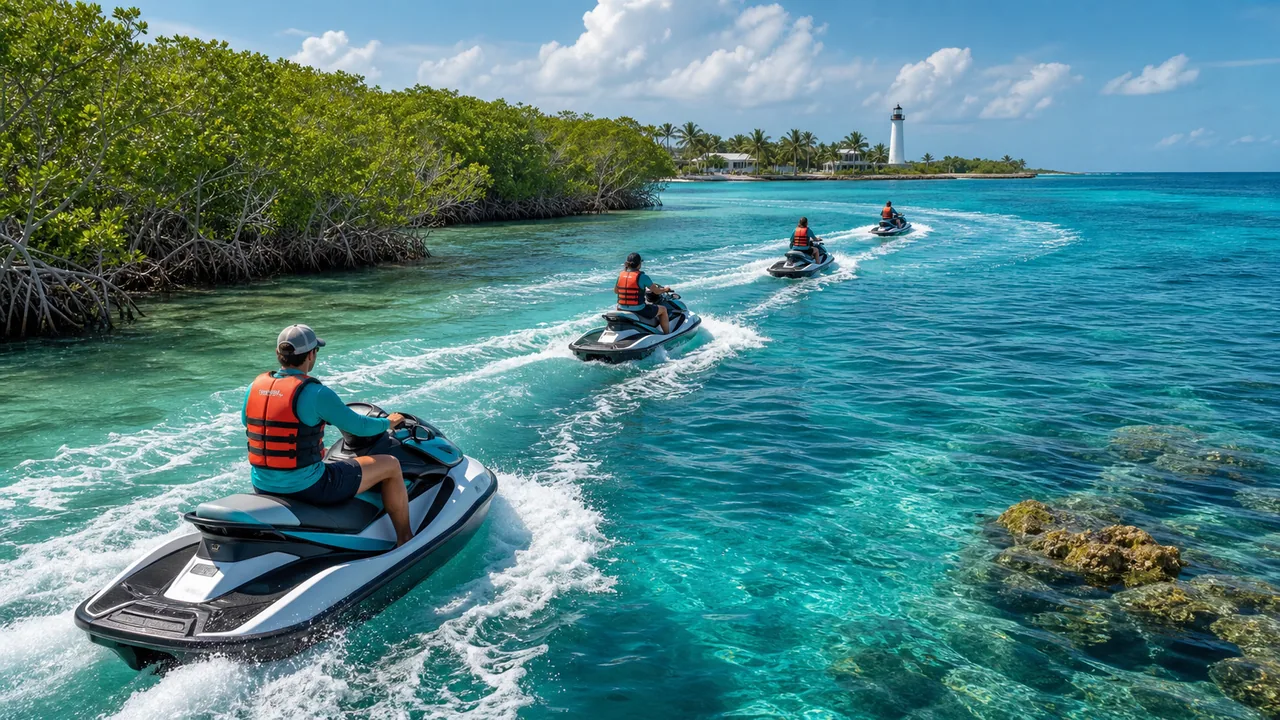
One sentence in Fury's current FAQ exposes the biggest Key West jet-ski booking trap: its Ultimate Adventure includes about fifteen to twenty minutes of riding per couple. That is a sample inside a multi-activity day, not the same product as a dedicated 90- or 120-minute guided tour. An all-day package can therefore include far less throttle time than a shorter island-loop listing.
That distinction is where review research becomes useful. The revealing accounts say what was purchased, who was eligible to drive, how the guide managed the group, whether the machine worked properly, why the route changed, and what the company did when ride time was lost. A bare five-star comment about speed or scenery cannot answer those questions.
Before the card is charged
Send the desk every driver's birth date and the exact rider pairing
The written reply should name the ID, test, parent-at-check-in rule, passenger limit, and whether the pair may switch drivers.
Fury's 15–20 minutes belongs in the sampler column
Fury's FAQ assigns roughly fifteen to twenty jet-ski minutes per couple on Ultimate Adventure. Put that number under ride time. Put the package's snorkeling, water-park, meal, and sailing time in another column. Combining them produces a large duration that does not describe the jet-ski segment.
A dedicated tour has to be priced against its own promised riding window. Ninety minutes with a guide, route briefing, stops, and an attempted island circuit is a different purchase. Neither is inherently better: the sampler serves a mixed-interest group; the dedicated booking serves the person who came to ride.
The paperwork is part of the product
Florida rules and livery requirements can require a boating-safety test or recognized certificate based on the operator's date of birth. Local operator guidance commonly requires government photo ID and earlier arrival for testing.
Age rules also differ for solo driving, driving with a passenger, and riding behind another adult. A natural parent may be required at check-in for a minor. Send dates of birth and rider pairings to the operator rather than assuming an online checkout proves eligibility.
“Tour cut short” describes three different records
The phrase by itself is useless. I separate the records before reading the star rating.
- Full ride time, different route: preserve launch and return times, the planned and substitute course, and the guide's reason for changing it.
- Less ride time after a late launch or equipment fault: preserve the minutes lost, any replacement machine, and the refund, credit, or rebooking decision.
- Rider ended the trip: preserve whether fear, discomfort, unsafe conduct, or impairment caused the stop and what the written cancellation terms said.
Damage and condition belong in one dock record
A damage complaint starts before anyone touches the throttle. The useful file contains the staff-witnessed walk-around image, signed waiver and card authorization, the later scratch, grounding, collision, lost key, or fault, and the company's image or invoice. The disposition of the hold—released, reduced, or charged—finishes the record.
At handoff I care about five things: throttle response; display and warning lights; shutoff and lanyard; fitted life jacket; stop signal and following distance. Cosmetic wear does not answer those questions. If odd steering or a warning appears in the no-wake area, the review should pair the defect with the dock's response: note, explanation, repair, swap, or refusal.
The rear seat is a separate buying decision
The driver sees chop coming and controls the throttle. The passenger absorbs turns and spray without either advantage. Two confident adults may love the same long route that leaves an uncertain passenger looking for an early exit. That is why passenger comfort deserves its own line in the review.
One prepayment message can settle the contract: birth date for every possible driver; who shares; whether they will switch; boating credential and photo ID; parent-at-check-in rule; combined-weight limit; passenger charge; per-person or per-craft price; test fee; fuel; tax; photographs; deposit or authorization. A three-seat machine answers none of it.
A cruise-ship schedule needs transport, testing, waiver, fitting, riding, and the return to the ship—not merely the advertised tour length. Secure storage matters too. The rear rider's pocket and a loose waterproof phone case are poor substitutes.
The Florida cutoff date is January 1, 1988
Florida's current boating-education rule applies to many personal-watercraft operators born on or after that date. A qualifying visitor can use an approved temporary certificate, but a normal driver's license is not the boating credential. Any passenger who may take the controls has to qualify as a driver before the switch.
The rental company can impose a higher driving age or a parent-at-check-in condition beyond the state minimum. Complete the operator-approved test before arrival when that option exists; the dock is a poor place to discover that a delayed or failed test will consume the departure.
What chop and shallow water change
Open-water chop turns the ride into a grip, balance, and passenger-comfort test. Shallow flats turn it into a navigation test. A first-timer worried about climbing back aboard after a fall may be happier on a shorter protected route; owning or riding a personal watercraft elsewhere does not remove the guide's local spacing and route rules.
Near seagrass, slower can be the correct service. NOAA's Florida Keys responsible-boating guidance tells boaters to avoid shallow-water and wildlife damage. A review of a detour should therefore preserve three facts: the guide's stated reason, total riding time, and the replacement route. That record can reveal a missed promise, or it can reveal a guide refusing to trade habitat for a mileage claim.
Sources and verification
Rules and public requirements link to the responsible agency. Business-specific service claims are checked against privately retained official material, while public ratings remain attributed to their original source. RealReviews does not turn outside reviews into invented testimonials, blend unrelated platforms into a house score, or sell placement in these comparisons. Recheck licenses, availability, scope, and price before hiring.
Frequently asked questions
Do I need a boating license for a Key West jet ski tour?
Yes, if Florida's boater-education rule applies to you. A driver born on or after January 1, 1988 generally must carry a Florida boating-safety ID card or qualifying temporary certificate with photo identification. Complete the operator-approved test before arrival when offered; a paid tour reservation does not waive the state requirement.
Can a 16-year-old drive a jet ski?
Yes, Florida permits a person age 14 or older to operate a personal watercraft, but a 16-year-old may still need boating-safety credentials, photo identification, and a parent or guardian at check-in under the operator's contract. The rental company can impose a higher driver age than the state minimum, so use the exact product's written rule.
Do jet ski tours always circle Key West?
No. Weather, traffic, ability, and safety conditions can change the route, even when the island loop is the planned product.
Can I freely rent a jet ski in Key West without a guide?
Usually no. Most visitor products in Key West are guided tours because of shallow water, navigation, traffic, and protected habitat. If unrestricted riding is the goal, require the operator to state the permitted riding area, supervision, route limits, and damage authorization in writing; do not infer freedom from the word rental.
What documents should a jet-ski driver bring?
Ask the operator for current photo-identification and boating-education requirements. Digital copies may not be accepted.