
Independent Key West pest-control guide
Key West Pest Control: Compare Licenses, Service Scope, and Five Providers
Compare five source-resolved Key West pest-control options by Florida license category, exact location, service boundary, termite scope, commercial fit, and proposal terms.
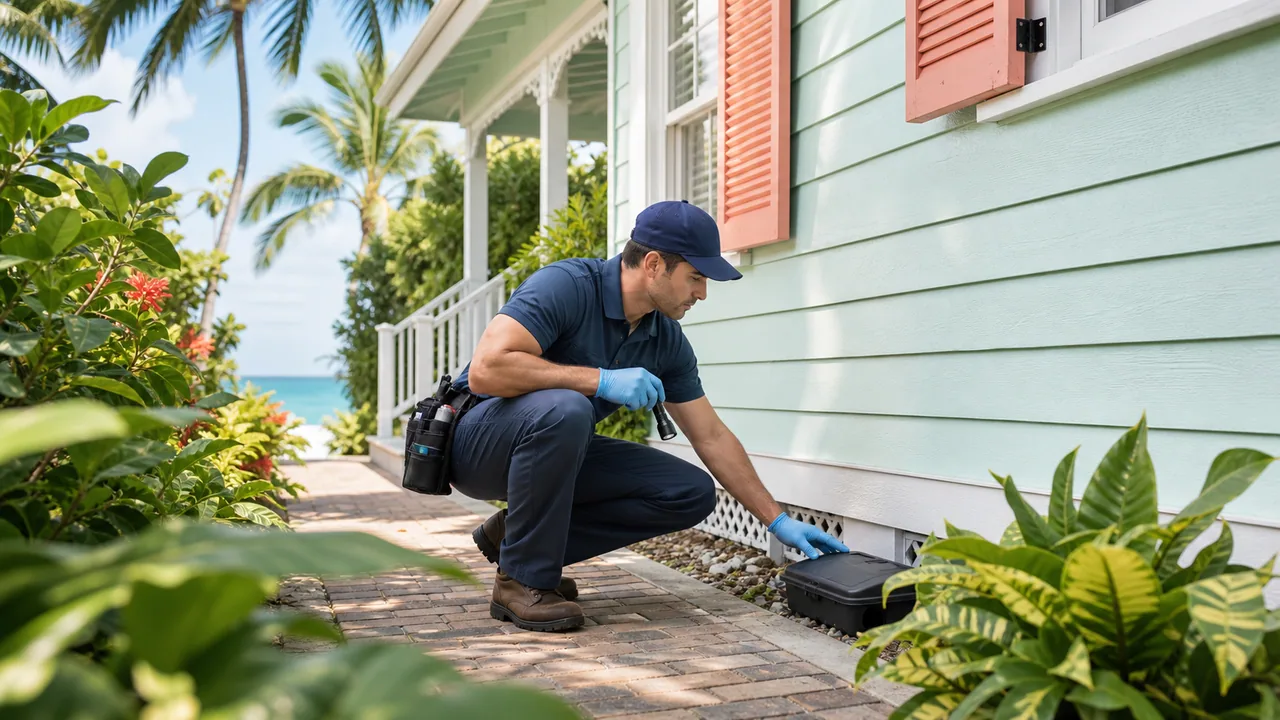
For a Key West pest-control job, the pest determines the license category before a company name enters the comparison. General household insects and rodents, wood-destroying organisms, lawn and ornamental work, and fumigation are separate Florida categories. A company can advertise termite service while the exact business-location license found in the state record does not show Wood-Destroying Organism coverage. That mismatch changes who should inspect or treat the property.
Five identities have enough current first-party and regulator evidence to compare without borrowing ratings or facts from unrelated records: Terminix at 625 US Highway 1, Orkin Branch 194 at 5684 Maloney Avenue, Keys Pest Control at the same Maloney Avenue address, Williams Pest Control as a Big Pine Key business advertising Keys-wide service, and Keys Pest Solutions at 1200 Fourth Street. The shared Orkin and Keys Pest address needs to remain visible. Williams is a service-area option, not a Key West storefront. Keys Pest Solutions is licensed in the audited record for General Household Pest and Rodent Control only.
A better pest-control quote starts with evidence
Send the pest, property, access, and proposal requirements once
Describe the activity, affected rooms or units, property use, deadline, prior treatment, access, and the exact license category the job may require.
Local businesses compared
These are identity-checked local profiles, not paid placements. The fit notes describe differences supported by current official information; ratings shown remain attributed to their outside source.
- Model
- Corporate Key West branch at 625 US Hwy 1 Ste 101. The audited FDACS business-location record is Rentokil North America, Inc. dba Terminix, license JB350306.
- Best starting fit
- A comparison quote for general household pests, rodents, WDO or termite work, or fumigation when the customer wants an exact-address branch and regulator record that align.
- Why it is on this list
- The official branch and FDACS record align on the US Highway 1 location. The audited license shows Fumigation, General Household Pest and Rodent Control, and Wood-Destroying Organism through April 1, 2027.
- Confirm before booking
- The audited license does not show Lawn and Ornamental. Corporate service claims do not establish availability, price, a guarantee, or job quality for a particular Key West property.
- Model
- Corporate Key West branch at 5684 Maloney Avenue. The audited FDACS record is Orkin, LLC, license JB1068.
- Best starting fit
- A comparison quote when the job may require household-pest, rodent, WDO, lawn and ornamental, or fumigation category coverage.
- Why it is on this list
- The official branch and FDACS location align. The license shows all four structural-pest categories through January 31, 2027 and lists Marcello Vani and Richard Mitchell as certified operators in charge.
- Confirm before booking
- The address is also used in the Keys Pest Control regulator record. Keep the brands and their ratings separate, and ask which legal entity will contract, inspect, treat, and stand behind follow-up.
- Model
- Key West pest-control identity whose direct site is current and whose FDACS record, license JB347411, uses 5684 Maloney Avenue.
- Best starting fit
- A local comparison for household pests, rodents, WDO, lawn and ornamental work, or fumigation after the customer resolves the current Orkin relationship and phone discrepancy.
- Why it is on this list
- The audited license shows all four categories through January 31, 2027 and Gilbert Font as certified operator in charge. The site and regulator record use different phone numbers.
- Confirm before booking
- The FDACS record shares the Orkin branch address and uses an orkin.com email. Do not infer independent ownership, transfer ratings between the brands, or rely on an unqualified family-owned claim.
- Model
- Big Pine Key licensed business advertising service from Key West to Key Largo; it is represented here as a Florida Keys service-area provider.
- Best starting fit
- A Keys-wide comparison for general household pests, rodents, WDO, or lawn and ornamental work when a Key West storefront is not required.
- Why it is on this list
- FDACS license JB146038 uses 29526 Ranger Avenue in Big Pine Key, shows three categories through May 31, 2027, and lists Keith Williams as operator in charge. The official site publishes Key West-to-Key Largo coverage.
- Confirm before booking
- The audited license does not show fumigation. Do not reuse the contaminated RealReviews Williams record with its mismatched South Street address, phone, or outside rating.
- Model
- Key West business at 1200 Fourth Street Unit 1112 with an exact-match direct phone and FDACS General Household Pest and Rodent Control license.
- Best starting fit
- A comparison quote for household insects, rodents, inspection, exclusion planning, or recurring general-pest prevention within the category supported by the audited license.
- Why it is on this list
- FDACS license JB500039 is active through May 6, 2027 and lists Odayne Walker as certified operator in charge. The direct site and regulator record align on 305-848-4627.
- Confirm before booking
- The audited business license does not show WDO, fumigation, or lawn and ornamental. Do not treat website termite language as state-category verification, and do not use the site's since-2016 phrase as the age of the LLC filed in 2025.
Use the license category as the first filter
Florida licenses structural pest-control business locations and requires a certified operator for the category in which work is performed. The category is not a decorative credential. General Household Pest and Rodent Control covers the ordinary indoor-pest and rodent lane. Wood-Destroying Organism is the category to look for when the assignment involves termites or another WDO inspection or treatment. Lawn and Ornamental and Fumigation are separately listed categories.
For general household pests and rodents, the July 26 audit found category support for Terminix, Orkin, Keys Pest, Williams, and Keys Pest Solutions. For WDO work it found Terminix, Orkin, Keys Pest, and Williams. For lawn and ornamental work it found Orkin, Keys Pest, and Williams. For fumigation it found Terminix, Orkin, and Keys Pest. The comparison is dated because licenses, operators, addresses, and categories can change.
Search the exact business name and location that will appear on the proposal. A national brand can operate multiple licensed locations, and a service page is not the state license. Save the result with the proposal and ask the salesperson to identify the certified operator responsible for the applicable category. A license establishes authorization recorded by the regulator; it does not establish a low price or successful outcome.
The five-provider license and identity matrix
Terminix is the cleanest exact-address match in this set: its official branch uses 625 US Hwy 1 Ste 101, and the regulator record uses 625 US Highway 1. JB350306 lists Fumigation, General Household Pest and Rodent Control, and WDO, with Les Wattenberg as operator in charge and an April 1, 2027 expiration in the audited record.
Orkin Branch 194 is also an exact-address match at 5684 Maloney Avenue. JB1068 lists all four categories and two certified operators in charge. Keys Pest Control's separate JB347411 record uses the same address, lists all four categories, and contains an Orkin email while its direct site publishes a different phone. That is a material identity relationship, not a reason to merge external ratings, reviews, or source histories.
Williams is licensed from 29526 Ranger Avenue in Big Pine Key under JB146038 and advertises service from Key West to Key Largo. Its profile must retain that service-area model. Keys Pest Solutions resolves to 1200 Fourth Street Unit 1112 under JB500039, but the audited category is limited to General Household Pest and Rodent Control. A smaller scope stated accurately is more useful than a longer menu inferred from marketing.
- Terminix JB350306: household/rodent, WDO, fumigation; US Highway 1 branch.
- Orkin JB1068: household/rodent, WDO, lawn/ornamental, fumigation; Maloney Avenue branch.
- Keys Pest JB347411: all four categories; shared Orkin address and email require disclosure.
- Williams JB146038: household/rodent, WDO, lawn/ornamental; Big Pine Key service-area business.
- Keys Pest Solutions JB500039: household/rodent only in the audited record; Fourth Street identity.
Termite and WDO work requires more than a termite page
For a termite inspection, real-estate WDO report, localized treatment, or whole-structure proposal, require the exact business location's WDO category. The current audit supports Terminix, Orkin, Keys Pest, and Williams for that category. It does not support Keys Pest Solutions for WDO, even though its site discusses termites. The regulator record, not the menu wording, controls the category representation on this page.
Describe the evidence before asking for treatment: swarmers, discarded wings, mud tubes, damaged wood, frass, moisture, previous reports, prior treatment, inaccessible areas, and the transaction or insurance deadline. Ask whether the first visit is an identification inspection, a formal WDO report, or a treatment proposal. Those are different deliverables.
A proposal should name the organism or evidence addressed, inspected areas and exclusions, inaccessible areas, method, preparation, occupied-space rules, product documentation, retreatment conditions, repair exclusions, warranty transfer, renewal charge, and who controls future inspections. For a condominium, determine whether the affected component belongs to the unit owner or association before authorizing common-area or structural work.
Bed bugs, rodents, and recurring pests need different briefs
A bed-bug request should state the number of rooms or units, occupied and vacant status, guest turnover deadline, evidence locations, prior treatment, adjacent-unit access, laundering capacity, furniture disposal plans, and who can complete preparation. Ask how the company confirms activity, treats adjoining risk, checks progress, handles a failed preparation, and prices follow-up. Do not let a broad recurring-service contract substitute for a bed-bug scope.
A rodent request should identify droppings, noises, sightings, food or nesting evidence, known openings, roof and attic access, crawlspace, kitchen or refuse areas, neighboring construction, and whether the goal is trapping, exclusion, sanitation correction, monitoring, or all four. Ask who closes entry points, what materials are used, which openings are excluded from the quote, how carcasses or traps are handled, and how success is measured.
For roaches, ants, stored-product pests, or a recurring prevention plan, send the activity pattern, rooms, moisture or food sources, prior products, sanitation or repair work already completed, pets, aquariums, occupancy, operating hours, and access. The company should return a pest-specific treatment and monitoring plan rather than only a calendar and monthly price.
Hotels, restaurants, rentals, and associations need operating controls
A Key West hotel or vacation-rental operator should attach the room or unit count, occupancy calendar, turnover windows, guest-communication limits, affected and adjacent spaces, housekeeping observations, prior service logs, inspection requirements, and whether a written log must be retained. A proposal should state visit timing, documentation, escalation, follow-up, preparation responsibility, and what happens when a unit cannot be entered.
Restaurants and food operations need a scope built around the pest evidence, receiving, storage, drains, grease, refuse, exterior pressure, operating hours, sanitation observations, documentation, and areas that cannot be treated during production. Pest control does not replace sanitation, exclusion, plumbing, building repair, or food-safety obligations. Assign each corrective action and deadline rather than leaving a general recommendation in the service report.
For a condominium or HOA, identify unit, common area, structural component, landscaping, association approval, notice requirements, master service agreements, key or escort rules, and responsibility for neighboring-unit inspection. Ask for the license category that matches each part of the job. An indoor household-pest contract does not silently include landscape treatment or WDO work.
Mosquito-control districts and private property treatment are different
The Florida Keys Mosquito Control District conducts public mosquito-control operations and accepts service requests. That public function is not the same product as privately purchased treatment on a residence, hotel, restaurant patio, event area, or association property. A district response does not create a private recurring-service contract, and a private yard proposal does not represent the district.
For private work, describe the outdoor area, vegetation, standing water, drainage, event or recurring use, neighboring pressure, pets, water features, and the result sought. Ask the provider to distinguish source reduction, larval control, adult mosquito treatment, timing, weather limits, label restrictions, retreatment, and monitoring. If lawn or ornamental pesticide work is included, verify the exact business license category.
Keep expectations measurable. No outdoor plan can promise a pest-free island property. A useful proposal identifies the area, method, visit frequency, conditions that postpone service, customer actions, documentation, and what triggers reassessment.
Build a proposal that exposes the complete price
No comparable Key West quote sample was collected for this audit, so this page does not invent an island-wide average. A defensible comparison starts by sending every finalist the same property, pest, evidence, affected area, urgency, access, occupancy, prior treatment, service goal, and license-category need. Then require the same price fields.
The proposal should separate inspection or dispatch charge, initial treatment, materials or special equipment, preparation support, follow-up visits, monitoring, exclusion or repair work, multi-unit or adjacent-area work, after-hours scheduling, documentation, recurring visits, renewal, taxes, and any cancellation or early-termination amount. Ask whether the initial fee is credited, which findings can change the price, and whether additional authorization is required before work expands.
A guarantee is useful only when its trigger and exclusions are written. Record the covered pest, term, required customer actions, number and timing of retreatments, response process, excluded conditions, renewal price, transfer rules, and remedy if activity continues. Compare the expected first-year total under the same visit and follow-up assumptions, not the smallest monthly number.
Preparation, re-entry, and product questions belong in writing
Ask for the preparation list before authorizing the appointment. It should identify food, dishes, toys, bedding, furniture, cabinets, aquariums, pets, people, ventilation, access, laundering, disposal, and any item that must remain undisturbed. For lodging or food operations, assign the person who verifies completion and the rule for a failed preparation.
Require the product name, EPA registration information when applicable, target pest, proposed area, label-directed precautions, re-entry instruction, and the contact who answers a product or exposure question. Do not ask a broad website form to collect diagnoses, pregnancy details, or unnecessary medical information. Tell the company only the practical constraint and request written instructions appropriate to the product and site.
If the method changes after inspection, request the revised scope, preparation, price, schedule, and follow-up before treatment. Keep the inspection findings, proposal, labels or product documents, service reports, photographs, invoices, guarantee, and communications together.
Read ratings only after the identity is resolved
An outside star average cannot tell a reader which Key West branch performed the work, whether the job required WDO or fumigation, or whether a shared address represents one operating team or separate brands. Keep the platform, rating, review count, branch, and retrieval date attached. Never move a rating from the polluted Terminix, Orkin, or Williams records into the clean profiles.
The current evidence set did not include a normalized inspection of at least five relevant review bodies for each exact business and service. This guide therefore makes no recurring praise or complaint claims. A selected testimonial, map aggregate, or snippet can point to questions, but it does not support a RealReviews consensus.
When reading recent feedback, match the service, branch, property type, and date. Separate communication, scheduling, identification, preparation, follow-up, billing, and guarantee administration. One dramatic complaint and one selected compliment are isolated observations until a larger relevant body establishes recurrence.
The booking test for each provider
Terminix has the strongest evidence-based fit when the customer wants a branch whose official and regulator addresses align and needs household, rodent, WDO, or fumigation category coverage. Orkin offers the broadest audited category set at its exact branch address. Neither conclusion predicts price or outcome; the proposal and current license still control.
Keys Pest remains a plausible local option across all four categories, but the Orkin address, regulator email, and phone discrepancy must be resolved in the contracting conversation. Ask which legal entity appears on the agreement and which team, operator, guarantee, billing system, and brand will handle the work. Do not accept the shared address as proof that ratings or obligations transfer.
Williams is a legitimate service-area comparison when Big Pine Key dispatch fits the job and its three audited categories match the assignment. Keys Pest Solutions is a clean exact-identity comparison for general household pests and rodents, but its narrow audited category boundary is decisive for termite, lawn, or fumigation requests.
The winning proposal should match the pest and property, identify the licensed location and operator, disclose the method and products, assign preparation and access, define follow-up and measurable completion, show guarantee exclusions, state the recurring term and cancellation, and total the price. If any of those elements remain verbal, request a revision before scheduling.
A treatment proposal should identify the pest and the endpoint
Ask the company to name the target pest, show the evidence supporting that identification, describe the treatment area and product class, and state what improvement should be visible by a specific date. A recurring plan should explain what is inspected at each visit and what triggers a different method. Without an endpoint, a low monthly price can become an indefinite expense.
For termites, rodents, wildlife, bed bugs, or a suspected structural entry point, clarify which repairs, exclusions, monitoring devices, follow-up visits, and warranties are included. Keep the label, service report, technician name, license information, and re-entry instructions with the property records.
If the diagnosis remains uncertain, pay for inspection and documentation before committing to a broad recurring program.
Sources and verification
Rules and public requirements link to the responsible agency. Business-specific service claims are checked against privately retained official material, while public ratings remain attributed to their original source. RealReviews does not turn outside reviews into invented testimonials, blend unrelated platforms into a house score, or sell placement in these comparisons. Recheck licenses, availability, scope, and price before hiring.
Frequently asked questions
Which license category should a Key West termite company have?
Require Wood-Destroying Organism coverage on the current FDACS license for the exact business location that will inspect or treat the property. The July 26, 2026 audit found WDO on Terminix JB350306, Orkin JB1068, Keys Pest JB347411, and Williams JB146038. It did not find WDO on Keys Pest Solutions JB500039. Recheck the live record before signing because categories and operators can change.
Does a pest-control website prove the company is licensed for termites?
No. A service page proves what the business advertises, while the FDACS business-location record shows the licensed categories found in the state system. For example, Keys Pest Solutions discusses termites online, but its audited license showed General Household Pest and Rodent Control only. Match the proposal's legal entity and location to a current WDO category before authorizing termite work.
Should Orkin and Keys Pest reviews be combined because they share an address?
No. Keep each brand's rating, review count, source history, contract, and guarantee separate unless authoritative evidence establishes that the exact review body belongs to the same operating entity and service. Their audited records share 5684 Maloney Avenue, and the Keys Pest record contains an Orkin email, but that relationship does not make every outside rating transferable. Ask which legal entity and brand will perform the work.
Can a Big Pine Key pest company be a Key West option?
Yes, when the business publishes a Key West service boundary and the dispatch model fits the property. Williams Pest Control's audited business location is in Big Pine Key, while its official site advertises service from Key West to Key Largo. Treat it as a service-area provider, not a Key West storefront, and ask how travel, scheduling, follow-up, and emergency returns affect the complete proposal.
What should a Key West pest-control proposal include?
Require the licensed legal entity and location, certified operator or category responsibility, identified target, inspected and excluded areas, method and products, preparation, re-entry, visit schedule, monitoring, follow-up, retreatment trigger, guarantee exclusions, recurring term, renewal, cancellation, every one-time and recurring charge, and authorization rules for added work. A monthly price without those terms is not a comparable proposal.
Is public mosquito control the same as private yard treatment?
No. The Florida Keys Mosquito Control District performs public mosquito-control work and accepts service requests. A private company proposal covers the customer's property under its own scope, schedule, products, weather rules, monitoring, and price. Use the district for its public service path; use a private proposal when the property needs a defined event, landscape, hotel, restaurant, or recurring plan.
How should a vacation rental request pest service between guests?
Send the unit, affected and adjacent rooms, evidence, prior treatment, checkout and next-arrival times, preparation capacity, key or escort process, and who can authorize added work. Require the provider to return the earliest lawful service window, preparation and re-entry instructions, follow-up timing, documentation, and contingency if the room cannot be occupied. Do not promise a same-turn resolution before the method and label requirements are known.
Can RealReviews call one Key West pest company the best?
No single company is the evidence-backed winner for every pest category. Orkin has all four categories in the audited branch license; Terminix lacks lawn and ornamental in its audited record; Williams lacks fumigation; Keys Pest has all four but a visible Orkin identity complication; and Keys Pest Solutions has only household and rodent coverage in the audited record. Match the category, identity, proposal, and property instead of a blended star average.