
Key West eco-tour comparison
Key West Kayak Tour Reviews: Mangroves by Day or Glass-Bottom at Night?
Compare Lazy Dog's mangrove eco tours, Night Kayak's illuminated trips, rentals, and private paddles by wildlife, effort, water clarity, and beginner fit.
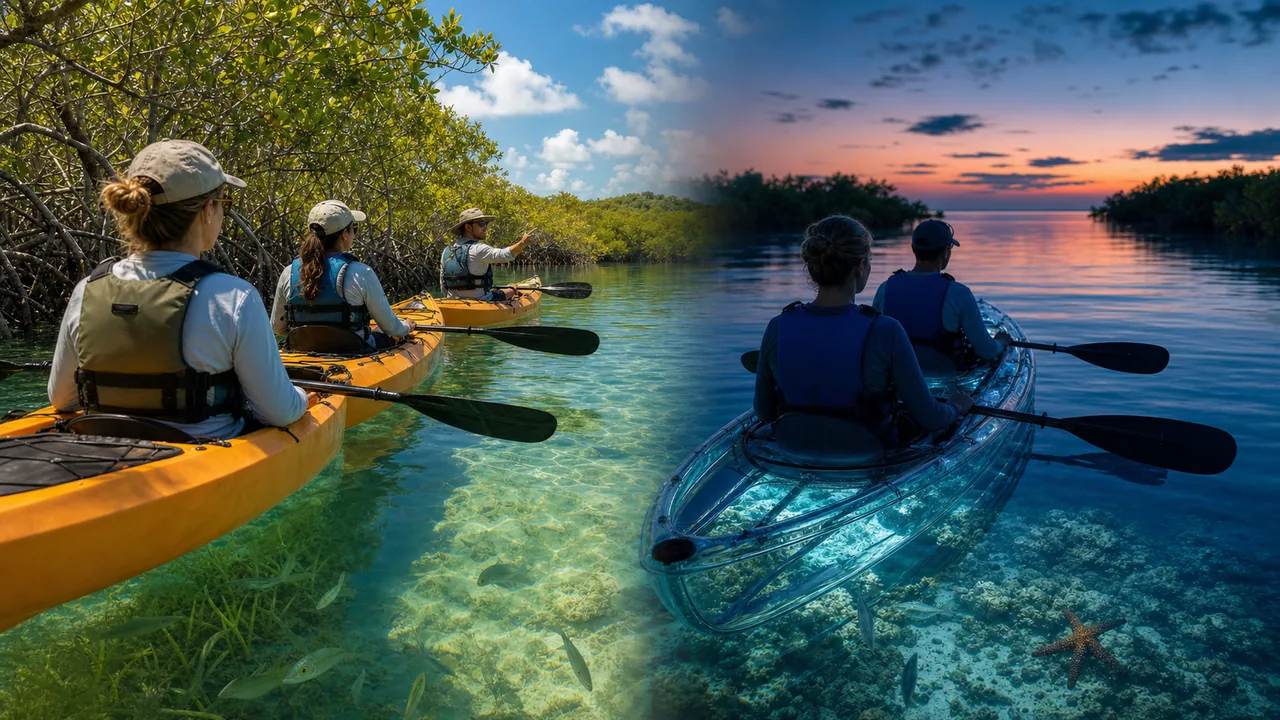
Daytime mangrove tours and nighttime illuminated kayaks are sold under the same activity label but produce different experiences. Day tours emphasize ecology, navigation through sheltered channels, and what a guide can identify. Night tours emphasize the glow beneath a clear hull and the novelty of being on dark water.
Neither format guarantees wildlife or perfect visibility. The better choice follows your comfort in a small craft and what you want the guide to teach.
Match the paddle to the group
Request a tour with experience and mobility details
Include first-time paddlers, children, and any difficulty getting into a low seat so the operator can recommend the right craft.
Start with the product, because the names blur together
Lazy Dog's guided outing is a daytime mangrove experience based from Stock Island. Night Kayak Key West is an after-dark attraction built around a transparent or clear-bottom craft lit from below. A rental removes the guide and leaves the route, pace, and return decision with the paddler. Those are three different purchases even when a booking site places all three beneath the word kayak.
For a first visit, the daytime guide is the dependable choice. Daylight makes the roots, turns, shoreline, and the guide's stroke demonstration visible. It also gives the naturalist more to work with: small fish among the roots, birds along the edge, and life attached to the shallows can carry an outing when no large animal appears.
Night Kayak's lighted boat is the attraction. Treat anything visible beneath it as a bonus. That makes the choice fairly plain: book the night trip if paddling across dark water in an illuminated hull sounds fun by itself; book daylight for easier photography and more time learning what lives around the mangroves. For a family split between those interests, the nervous or curious paddler should decide—not the person choosing the evening's most dramatic photograph.
Try the awkward part of the trip in your head
A person can spend an afternoon walking Old Town and still struggle to lower into a kayak seat. The useful test is not general fitness. It is whether that guest can step into the craft, bend enough to sit low, repeat a paddle stroke, and climb out again while wet. A stiff knee, sore shoulder, uncertain balance, or a child who may quit paddling changes the boat choice.
Give the operator the actual limitation: “One guest cannot bend her right knee fully. How do you launch, can staff help, and would you place us in a tandem?” That answer should tell you more than the word beginner-friendly. A tandem lets the stronger paddler carry more of the work, although two people still have to coordinate the steering.
Night is a separate decision. Someone who depends on a visible horizon or dislikes dark open water may be comfortable on the same route in daylight. Settle that before the cancellation deadline.
Two hours on the listing is not two hours in the kayak
Check-in, a waiver, PFD fitting, instruction, transport to the launch, and equipment return can all sit inside the advertised duration. On a combination excursion, sailing, snorkeling, lunch, or a sandbar may leave only a short portion for paddling. That can be a good family day with a support boat and restroom. It is the wrong bundle when the kayak is the reason for going.
Ask how many minutes guests normally paddle and whether the route is mostly narrow mangrove water or open water. The channel may block some wind while requiring tight turns around roots. Open water is easier to turn in but brings more sun, wakes, current, and a possible upwind return. The label “backcountry” answers none of that.
The tunnel in a sales photograph may be unavailable at the booked tide or wrong for that group and weather. A guide who chooses another channel to protect the habitat or keep control of the boats is doing the job. The reservation buys a mangrove outing, not the right to reproduce one photograph.
Three review details worth more than a wildlife photo
First, look for the conditions. Easy and exhausting can both be honest descriptions of the same water when one group leaves in calm morning air and another returns into an afternoon breeze. A useful account names the launch, water type, approximate group size, and weather.
Second, look for the response. A guide shortened the route before the slowest boat was spent, changed a tandem pairing, waited where instructions could be heard, or explained why a tunnel was wrong that day. Those ordinary decisions can recur. A dolphin or manatee sighting cannot.
Third, look for teaching. Fish, rays, birds, crabs, sponges, turtles, and larger visitors may use the shallows, but none is inventory. Repeated praise for noticing small organisms, explaining the mangrove nursery, and making a quiet day interesting is stronger evidence of an eco tour than one exceptional sighting.
The word eco is not evidence by itself. Group size, the number of boats one guide supervises, reusable equipment, wildlife rules, and relevant paddling, first-aid, or naturalist training are concrete questions. Do not infer a credential that an operator has not documented.
NOAA’s Florida Keys National Marine Sanctuary guidance adds the habitat test. Seagrass and shallow bottom can be damaged by careless landings, anchors, and paddles. A route change that protects habitat or keeps a mixed-ability group under control is evidence of judgment, not proof that the guide withheld the “best” channel.
For a rental, decide where you will turn around before launching
The cheap-looking rental stops being simple when the breeze rises on the way home. There is no guide to choose the channel or notice that the slowest boat needs to turn. Similar mangrove edges, glare, and spray also make a phone map harder to use from the seat than it was at the rental desk. If the desk cannot name the route and a conservative turnaround, do not improvise one from the water.
Before leaving, obtain a named route, its edges and hazards, the latest safe turnaround, required flotation, and a way to contact the operator. Read the National Weather Service Key West marine forecast close to departure. A blue patch above the launch says little about the wind on the return.
Rent when those judgments are already comfortable. Otherwise, the guide fee is buying local navigation as much as instruction.
A practical verdict for the common choices
Choose a Lazy Dog-style daylight eco tour for the strongest first-paddle value: visible water, naturalist interpretation, and a guide making local route decisions. Choose Night Kayak for an evening attraction whose central feature is the illuminated craft. Choose an independent rental only when the responsible paddler already wants the navigation problem.
Whichever format wins, compare pacing, group control, instruction, equipment, and the response to an ordinary problem. Those are service qualities an operator can repeat. Water clarity and wildlife are not.
A booking message that can produce a real answer
“Tuesday morning, two adults and a ten-year-old. The child is comfortable in water but may tire; one adult has limited right-shoulder motion. We want a daytime mangrove trip, not a multi-activity boat. What launch do you expect to use, how much time is normally spent paddling, and would you assign a tandem?” That note gives the operator a date, party, physical constraint, product, and decision.
Add any need for secure storage, a restroom near launch, pickup, or a dry change afterward. Essential medication deserves a specific storage answer. Splash-resistant is not the same as waterproof, and a marina address does not prove that lockers, towels, showers, or changing rooms exist.
One cancellation sentence deserves to be read twice
Find the sentence that separates an operator's weather call from a customer's cancellation. Wind, lightning, or an unsafe route may lead to a modified trip, credit, reschedule, or refund under the company's terms. Illness, lateness, or a guest who decides against dark water can use a different deadline.
A safer alternate channel may still count as the purchased tour when duration and the central mangrove experience remain. Save the terms with the meeting instructions. The storefront, parking area, marina entrance, and actual launch may be four different points.
Keep the camera subordinate to the boat
Ask when the group can stop without drifting into branches, motor traffic, or another kayak. A strap can prevent a dropped phone and create an entanglement problem; the operator's equipment rule controls. Wildlife should not be chased, fed, touched, crowded, or blocked for an image.
Water, sun protection, and shoes that stay attached belong with you; add insect protection when the operator recommends it. Leave breathing room before dinner, checkout, or a flight. A wet guest and a boat that reaches the dock a little late are ordinary possibilities, not a scheduling emergency.
Sources and verification
Lazy Dog's current material supports the Stock Island daytime-tour and rental distinctions used here; Night Kayak's material supports the illuminated after-dark format. NOAA sanctuary guidance supplies the habitat rules, and the National Weather Service supplies the marine forecast. Those sources do not promise a particular animal, tunnel, route, or water clarity. RealReviews treats those as conditions, not inventory.
Frequently asked questions
Do I need kayaking experience?
No. The usual guided eco tour can take a first-timer. Tell the operator about any stiff knee, shoulder problem, balance concern, fear of deep water, or child who may tire. The operator can then explain the launch and choose a solo or tandem instead of guessing from the label beginner.
Are clear-bottom night kayaks worth it?
Yes—if the glowing clear-bottom craft and the experience of paddling after dark are what you want to buy. The lights are the reliable feature; clear water and wildlife are not. Pick a daylight eco tour instead when seeing the surrounding habitat, following naturalist interpretation, or reassuring a nervous beginner matters more than atmosphere.
Can I kayak without a guide?
Yes, but rent only if you can read the marine forecast, follow a locally defined route, avoid boat channels and sensitive shallows, and set a turnaround time that protects the return leg. Knowing the basic stroke is not the same as navigating unfamiliar mangroves. A first-time visitor usually gets better value from a guide's route judgment.
Is a Key West kayak tour suitable for beginners?
Yes for many beginners; a guided daylight route in protected water is the strongest starting choice. The real test is whether the guest can manage the launch transfer, low seat, repeated shoulder motion, and any exposed crossing. Describe those limitations before paying so the operator can choose a tandem, easier launch, or a different outing.
Will every mangrove kayak tour use tunnels?
No. Tide may close the practical route; wind, habitat protection, or the group's boat control may make another channel smarter. If one tunnel photograph is the reason you are booking, ask before paying. Otherwise, judge the trip by the mangrove habitat and the guide's route choice.